

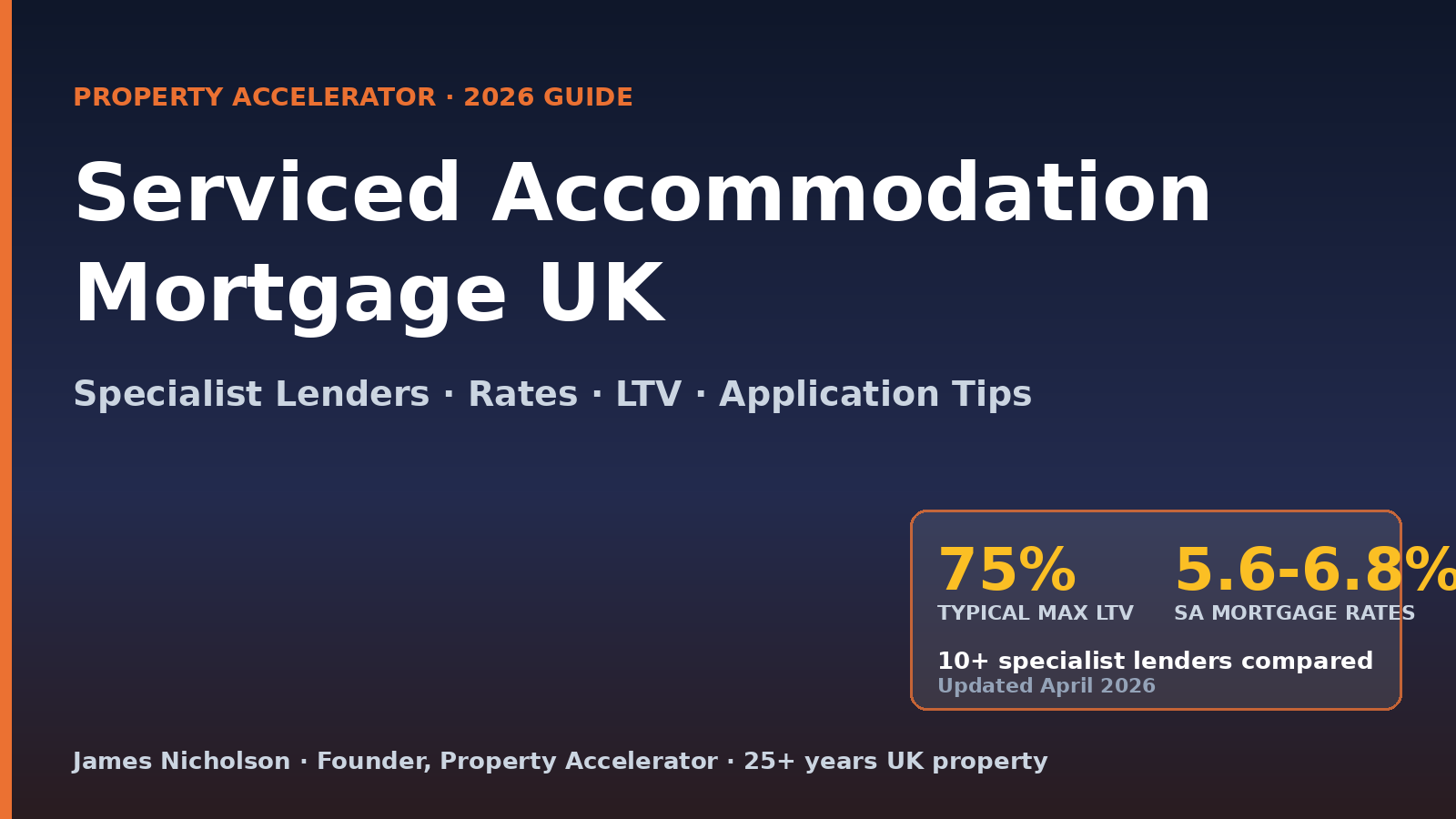
A serviced accommodation mortgage is a specialist buy-to-let product for properties let on a short-term basis (Airbnb, Booking.com, corporate lets). Expect 75% max LTV, rates 5.6%–6.8% as of April 2026, and minimum income of £25k. Most mainstream BTL lenders refuse SA — you need specialists like Paragon, Foundation, Cumberland, Hodge or Cambridge & Counties.
For the longer comparison, see our piece on why most UK investors run BTL alongside stocks.
Important 2025 update: the Furnished Holiday Lets tax regime was abolished on 6 April 2025. SA and FHL income is now taxed as standard rental income — this changed the maths for new buyers and how lenders assess affordability.
- What is a serviced accommodation mortgage?
- SA mortgage vs standard BTL vs holiday let
- The 2025 FHL tax abolition — what changed
- LTV, deposits, rates (April 2026)
- Specialist SA lender comparison
- How lenders calculate affordability
- Worked example: £250k SA flat, 5-year cashflow
- Application checklist
- SA mortgage gotchas by city/region
- 5 common SA mortgage mistakes
- FAQs
- SA mortgage glossary
Serviced accommodation mortgages are the financing product I get asked about more than any other these days. Demand for short-term lets has held strong through every cycle since 2020, but the lending landscape has tightened, the FHL tax breaks have gone, and the headline mortgage rates are 0.5–1% higher than standard buy-to-let. Investors keep getting caught out by trying to use a normal BTL product on an SA property — only to have the lender pull the offer at valuation.
This page is the version of the explanation I give every investor walking into our community asking how to finance their first or next SA deal. It’s been completely rewritten for April 2026 — including the post-FHL tax landscape that didn’t exist when most “SA mortgage” guides on the internet were written.
What is a serviced accommodation mortgage?
A serviced accommodation mortgage is a specialist buy-to-let product designed for properties let on a short-term basis — typically through Airbnb, Booking.com, VRBO, or directly to corporate clients on contracts of weeks or months rather than the standard 6–12 month AST.
The reason it’s a separate product from standard BTL: lenders assess risk differently when:
- Income is irregular. SA properties have peak and shoulder seasons, plus voids between bookings.
- Tenants change weekly. Higher wear-and-tear, more management overhead.
- The property may be in a planning grey zone. Some councils now require planning permission for properties used as SA — particularly in tourist areas.
- Resale market is smaller. Far fewer buyers want to inherit an SA business than would buy a single-let BTL.
If you try to put an SA property on a standard BTL mortgage, the lender’s valuer will flag the use class on inspection and the lender will either pull the offer or impose a “single-AST only” condition that means you can’t legally run it as SA. Get the financing right before you exchange.
SA mortgage vs standard BTL vs holiday let
Three closely-related products, distinct criteria. Here’s how they compare:
Strict definition: “Holiday Let” historically required compliance with HMRC’s Furnished Holiday Lets criteria (210 days available, 105 days actually let, etc.) to qualify for tax reliefs. “Serviced Accommodation” has always been the broader operational term — it includes FHLs but also corporate lets, longer stays, and properties that don’t hit the FHL day thresholds. After April 2025 the distinction matters less for tax (see next section), but lenders still maintain separate product ranges.
The 2025 FHL tax abolition — what changed
This is the single biggest change to UK SA investing in the last decade and most of the older “SA mortgage” guides online still don’t reflect it.
From 6 April 2025, the Furnished Holiday Lets tax regime was abolished. Before then, FHL properties enjoyed:
- Full mortgage interest deductibility (vs Section 24 cap on regular BTL)
- Capital allowances on furnishings and equipment
- CGT Business Asset Disposal Relief (10% rate vs 18%/24%)
- Pension contributions counted against rental profits
From April 2025 onwards, SA/FHL income is treated as standard rental income:
- Section 24 mortgage interest cap applies. If you own personally, mortgage interest gives only a 20% basic-rate tax credit, not full deduction. This made personal-name SA significantly less tax-efficient overnight.
- No more capital allowances. Furniture and equipment depreciation now follows normal property tax rules (replacement of domestic items relief only).
- CGT at 18%/24%. When you sell, the lower BADR rate has gone.
The practical impact: most new SA buys now go through limited companies (Section 24 doesn’t apply to Ltd Cos), and the lenders most active in this space have all updated their criteria. If you bought an FHL in your personal name pre-2025 expecting the old tax treatment to last, get accountancy advice — incorporation is sometimes the right move.
Reference: The Government’s official guidance on the abolition is on gov.uk.
Why choose an interest-only mortgage? (SA & BTL investor logic)
Almost every serviced accommodation and buy-to-let mortgage in the UK is taken out on an interest-only basis — not because investors can’t afford a repayment mortgage, but because the maths heavily favours interest-only for income-generating property. Here’s the honest investor logic.
The cashflow argument — the main reason
On a £200,000 interest-only mortgage at 5%, you pay £833 a month. The same £200,000 on a 25-year capital repayment mortgage at 5% costs £1,169 a month. That £336/month difference (£4,032/year) is pure cashflow improvement on your SA or BTL — and on a portfolio of 5 properties it’s £20,000/year of additional net cash. Interest-only is essentially trading capital build-up for current income.
Why this works for investments but not for your home
- The asset appreciates regardless of whether you pay down debt. UK property has averaged ~5-7% capital growth per year over rolling 10-year periods. You don’t need to pay capital down to build equity — the market does it for you, with leverage.
- Mortgage interest is the only tax-deductible cost on a Ltd-company BTL or SA. Capital repayment isn’t deductible. Interest-only maximises the tax-efficient portion of your monthly outgoing.
- The rent is what services the mortgage, not your day-job income. Lender stress tests are based on rental cover, and rental cover comes out much better on interest-only payments — meaning you can borrow more on the same property.
- You can voluntarily overpay when you want to. Most interest-only products allow 10% annual overpayments penalty-free. You haven’t lost the optionality of paying down debt — you’ve just untied it from the monthly direct debit.
Where interest-only goes wrong
- Property prices fall and you can’t refinance. If LTV drifts past 75% at the next renewal because values dropped, you may be forced into a worse product or have to inject cash. This was the 2008-2010 reality for many landlords.
- You forget you owe the principal at term-end. The mortgage doesn’t reduce. At year 25 you owe exactly what you owed at year 1. You need a credible exit plan: sell, remortgage onto a new interest-only product, or repay from other capital.
- Lender criteria change mid-term. Some lenders now require a documented repayment vehicle at application. “Sell the property” is generally acceptable; “I’ll figure it out” is not.
When interest-only is the right choice
- You’re buying buy-to-let, serviced accommodation, HMO, or any income-producing property. Default to interest-only.
- You’re an income-tax higher-rate payer who owns via a Ltd company — interest-only maximises the deductibility advantage.
- You want to deploy cashflow into more deposits and grow a portfolio rather than pay down one mortgage.
- You have a clear exit plan in 20-25 years (sale, downsizing, generational transfer).
When repayment makes more sense
- Residential mortgage on your main home — interest-only on a residential is much harder to get and not the right risk profile for the asset you live in.
- You’re approaching retirement and want the property mortgage-free by a specific date.
- You bought at peak LTV (85%+) and want to actively reduce the balance to lower future remortgage risk.
- You only own one property and don’t intend to scale — capital build-up matters more than current cashflow.
The vast majority of SA and BTL mortgages in the UK are interest-only for exactly the reasons above. If you’re being pushed toward a repayment mortgage on an investment property, ask why — the answer should be specific, not generic.
Looking at Nationwide (via TMW) for your SA mortgage? They’re one of the biggest BTL lenders in the UK. See my breakdown of Nationwide mortgage lending criteria for 2026 covering residential and BTL/TMW rules.
LTV, deposits, rates as of April 2026
Rates change weekly. The figures below are typical specialist SA mortgage products as of April 2026 — your actual offer will depend on credit, deposit size, lender criteria, and the specific property.
- Maximum LTV: 75% on most products. A handful of specialists go to 80% on smaller properties under £400k. For first-time SA investors with no track record, lenders typically cap at 65–70%.
- Deposit on a £250k property: £62,500 at 75% LTV. Plus 3% stamp duty surcharge (£12,000+), legals (£1,500), valuation (£500), arrangement fee (£3,000–£5,000). All-in cash needed: ~£80–85k before any furnishing.
- Furnishing: SA properties need to be ready to operate from day one — bedding, kitchenware, towels, smart locks, Wi-Fi setup. Budget £8–15k for a 2-bed flat to a competitive standard.
- 2-year fixed rates (April 2026): 5.6%–6.4% for established SA investors, 6.0%–6.8% for first-timers.
- 5-year fixed rates: 5.8%–6.5%. Most experienced operators take the 5-year for cashflow stability.
- Tracker products: Rare on SA. Base rate + 2.0–2.5% if available.
The Bank of England base rate has been falling steadily through 2025 and 2026 but specialist lenders haven’t passed all of that through to SA-specific products yet — risk premiums have stayed elevated.
Specialist SA lender comparison
This is a snapshot, not a comprehensive list. Always go through a specialist mortgage broker — most of these lenders only distribute through brokers and don’t publish products direct.
For most investors I work with, my first three calls are Foundation (most accessible, lowest income threshold), Paragon (best for portfolio expansion), and Cumberland (best in tourist areas). If you’re financing through a Ltd Co, Foundation and Paragon both have purpose-built SPV products.
If you also own HMOs, the same specialist brokers cover both regimes — see my HMO mortgage guide for the lender list on that side.
How lenders calculate affordability
SA mortgage affordability assessment is more complex than standard BTL because the rental income isn’t a fixed monthly figure. Lenders use one of three approaches:
1. Long-term equivalent (most common). The valuer calculates what the property would rent for as a single AST and the lender applies a standard ICR test (rent must be 145% of mortgage interest at notional rate). This is the most conservative — many SA properties rent for materially more on short-term than long-term. You qualify, but the maximum loan size is constrained by the AST equivalent.
2. SA / FHL projection (specialist lenders). The valuer takes the projected SA gross income (often using AirDNA or local benchmark data) and applies a higher cost ratio (typically 30%) to get net income, then runs ICR on that. This unlocks larger loan sizes for properties with strong SA performance. Hodge, Cumberland and Foundation use this.
3. Top-slicing (small subset). If projected income is borderline, your personal salary can fill the gap. Paragon, Kent Reliance and Shawbrook offer this on SA products.
The valuer’s methodology matters more than the headline rate. A lender using approach 2 will lend you significantly more on the same property than a lender using approach 1 — because they’re recognising the SA income premium rather than treating the property as a long-let.
Worked example: £250k SA flat in a city centre, 5-year cashflow
To make this concrete — here’s a realistic numbers comparison for a £250,000 2-bed city-centre flat run as serviced accommodation, financed at 75% LTV.
The SA route nets ~£14k more over 5 years on this example. But — and this is the part most people miss — that’s before the management overhead. SA isn’t passive. You’re running a hospitality business: handling guest queries at 11pm, replacing broken toasters, managing cleaning teams, optimising listings on multiple OTAs. Most full-time SA operators value their time at £15–25 an hour and find SA stops looking attractive once that’s factored in. Hands-off SA via a managed letting agent typically takes another 20–30% off the gross.
SA mortgage gotchas by city / region
The single biggest mortgage approval blocker I see in 2026 isn’t the lender’s criteria — it’s local planning rules that affect whether the property can legally be operated as SA at all. The lender’s valuer will check before they recommend approval. Get the local rules straight first.
If you’re considering SA in a tourist hotspot, my Article 4 directions guide lists every council with restrictions, and my selective licensing guide covers the broader licensing landscape that may also apply.
Application checklist
Get these documents together before approaching the broker. Saves about 2 weeks on the average SA mortgage timeline.
- Last 3 months of bank statements (personal and Ltd Co if buying through a company)
- Last 2 years of SA302s (or 3 years if self-employed)
- Last 2 years of accounts (Ltd Co) or P60s (employed)
- Proof of deposit source (bank statement showing cash, gifted-deposit letter if applicable)
- Existing property portfolio schedule (addresses, values, rental income, mortgage balances)
- Income projections for the SA property — AirDNA report, comparable Airbnb listings, projected occupancy
- Planning permission documents if the local authority requires planning for SA use (London boroughs and Edinburgh particularly)
- Furnishing/setup costings if buying empty
- EPC (must be E or above to let, regardless of duration)
- Management plan — self-managed or via agent? Lenders ask
For first-time SA investors, lenders also want a written summary of why you’re choosing SA over standard BTL — the specialist nature of the product means underwriters want to see a thought-through investment case.
5 common SA mortgage mistakes I see weekly
I get on the phone with a couple of investors a week who’ve made one of these and are calling to ask whether it’s recoverable. Sometimes yes, sometimes the deal’s dead. All five are avoidable.
1. Buying the property first, financing second.
An investor I spoke to in February exchanged on a 2-bed Edinburgh flat for SA use, then went lender shopping. By the time he learned Edinburgh has a city-wide control zone requiring planning permission, the contract was signed. Lender refused. He completed on the property at family-let yields and lost £14k a year of projected SA income. Get the SA mortgage agreement-in-principle before you exchange — every time.
2. Not reading the lease on a leasehold flat.
London leasehold flats often have explicit “no short-term lets” clauses. The lender’s solicitor catches it at search stage. Even if the lender approves, the freeholder can serve a Section 146 notice for breach. Pull the lease BEFORE offering — your solicitor can read it in 20 minutes for £150.
3. Operating SA on a standard BTL mortgage to “save money”.
A landlord I worked with in 2024 ran his Cornwall flat as Airbnb on a BTL mortgage for 18 months — saved about £900 a year on the rate differential. When he came to remortgage, the new lender’s valuer pulled the bank statements showing booking platform deposits. Old lender invoked the breach clause. Refinance fell through, mortgage went onto SVR (8.4% at the time), insurance was voided. Don’t do this. The £900 saving isn’t worth it.
4. Modelling on peak-season occupancy.
Every AirDNA report shows peak summer hitting 85%+ in tourist locations. Investors take that number, project it across 12 months, and present it to the lender. Underwriters discount aggressively. Use blended annual occupancy — 55–65% for typical city centre, 60–75% for prime tourist locations, 35–45% for marginal areas. Underwriters know AirDNA too.
5. Personal-name purchase without checking Section 24 maths.
Post-FHL abolition (April 2025), Section 24 mortgage interest restrictions apply to SA properties owned personally. For higher-rate taxpayers, this can wipe out 30–50% of net cashflow. Run the maths through a Ltd Co structure before committing — or take accountancy advice if you’re already personal-name. Most new SA buys in 2025–26 are going via SPV Ltd Cos for this exact reason.
People also ask
Can you get a mortgage for serviced accommodation?
Yes — but you need a specialist lender. Standard buy-to-let mortgages don’t allow short-term lets, and using one for SA breaches the terms. The SA-friendly lenders I work with most often are Castle Trust, Cambridge & Counties, Aldermore (limited products), Hampshire Trust, and a handful of specialist commercial lenders. Expect rates 1-2% above standard BTL, typical loan-to-value of 70-75%, and stress tests based on monthly assured shorthold rent (not SA income), which often constrains how much you can borrow.
Is serviced accommodation a good investment?
SA can deliver gross yields of 12-25% in the right locations, vs 5-7% for standard buy-to-let — but it’s a more demanding business model than passive BTL. You’re running a hospitality operation: cleaning, restocking, guest comms, dynamic pricing, channel management. Returns depend heavily on location (city centre, near a hospital, business park, or tourist zone), seasonality, and whether you use a management company (which takes 15-25% of revenue). With the FHL tax wrapper abolished in April 2025, the tax case has weakened, but operational profits remain compelling for hands-on operators.
What is an example of serviced accommodation?
A typical SA unit is a self-contained flat or house let on a nightly or short-stay basis to corporate guests, contractors, hospital workers, or tourists. Think a 2-bed apartment in central Manchester let on Booking.com and Airbnb at £120/night, achieving 75% occupancy and grossing £33,000/year — vs £14,400 on a standard 12-month tenancy at £1,200/month. The trade-off is operating intensity: you’re running a hospitality business, not collecting rent.
What is a serviced mortgage?
There’s no formal product called a ‘serviced mortgage’ — it’s shorthand for a mortgage that permits short-term and serviced accommodation use. These are sometimes badged as ‘holiday let mortgages’, ‘Airbnb mortgages’, or ‘short-term let mortgages’. The criteria differ from standard BTL: lenders assess your hospitality experience, the property location’s tourist or corporate demand, and projected ADR (average daily rate) and occupancy. Many require a management plan and proof of supply contracts.
Is it easy to get a Ltd co mortgage on a property to use it for Serviced Accommodation?
Limited company SA mortgages are harder than standard BTL but increasingly available. Lenders want to see an SPV structure (no trading activity, just property), a personal guarantee from directors, and ideally some SA experience. Rates are typically 0.25-0.75% higher than personal-name SA mortgages, and many lenders cap LTV at 70%. The big four for limited co SA in 2026 are Castle Trust, Cambridge & Counties, Hampshire Trust, and Together. Expect a 4-8 week process and broker fees of £495-995.
Frequently asked questions
Can I use a standard BTL mortgage for serviced accommodation?
No. Standard BTL mortgage terms typically require the property to be let on an AST of 6+ months. Using a BTL product for SA is a breach of mortgage conditions and can void your insurance. Get the right product first.
Can I get an SA mortgage as a first-time landlord?
It’s harder but possible. Foundation, Cumberland and Suffolk Building Society accept first-time SA investors with no prior BTL experience. Most other specialists want at least 12 months of buy-to-let experience first. The workaround is to buy a single-let BTL first, hold for 12 months, then move to SA on subsequent purchases.
How much deposit do I need?
25% as a minimum (75% LTV is the standard ceiling). For a £250k property that’s £62.5k deposit plus stamp duty (3% surcharge = £12k+), legal fees (£1.5k), arrangement fee (£3–5k) and furnishing (£8–15k). All-in cash needed is typically £85–95k for a £250k SA property.
Has the FHL tax abolition changed mortgage criteria?
Indirectly — most lenders haven’t restated their criteria specifically because of the 2025 FHL changes, but the practical impact is that more SA buyers are now using limited companies (to avoid Section 24 mortgage interest restrictions). Specialist lenders are seeing strong demand on Ltd Co SA products as a result.
Can I get an SA mortgage on a leasehold property?
Yes, but the lease needs to permit short-term letting. Many leasehold flats — particularly in London and tourist cities — have explicit clauses prohibiting short-term lets in the lease. The lender’s solicitor will check this. If the lease prohibits SA, you can’t operate legally regardless of mortgage. Always check the lease BEFORE offering on any leasehold flat for SA use.
What about planning permission for SA properties?
This is increasingly the catch. London boroughs apply a 90-day annual cap on short-term lets without planning permission. Edinburgh has a city-wide control zone requiring planning for any SA conversion. Wales has introduced statutory licensing. Some English seaside towns (Whitby, St Ives, parts of Cornwall) have their own restrictions. Check the specific council’s rules — the lender’s valuer will check too.
Should I buy SA properties in my personal name or via a Ltd Co?
Since the FHL abolition in April 2025, the Ltd Co route is increasingly the default for new buys. Section 24 mortgage interest restrictions don’t apply to Ltd Cos, so the post-tax cashflow on a typical SA property is £1,500–£3,000 better per year via Ltd Co for higher-rate taxpayers. You’ll pay 0.2–0.4% higher mortgage rates and £400–800 more per year in accountancy fees, but the tax saving usually wins. Always take accountancy advice on your specific situation.
What occupancy rate should I model?
60% is a reasonable conservative starting point for city-centre 1–2 bed flats. Tourist hotspots in peak season can hit 80%+; struggling locations or out-of-season dead zones can be 35–40%. Use AirDNA market reports for the specific postcode — they’re £20–40 per report and worth it for due diligence.
What about properties already on a regular BTL — can I switch to SA?
Yes, but you need to remortgage to an SA product first. Don’t operate as SA on a BTL mortgage — even if no one notices today, the breach can be discovered at remortgage, sale, or if you make any insurance claim.
Can I switch from a holiday let mortgage to an SA mortgage mid-term?
Switching products mid-term means breaking your fixed-rate (paying ERCs of typically 1–5% of the loan) plus arrangement fees on the new product. It rarely makes sense unless rates have dropped significantly or your usage has fundamentally changed. Most operators wait for the natural remortgage window at end of fix.
Do SA mortgage lenders care about my Airbnb Superhost status?
Not directly — they don’t have a Superhost criterion. Indirectly, a strong host history with provable income (statements from Airbnb, Booking.com, etc.) helps the affordability case for top-slicing or income-based valuation. Bring 12+ months of platform statements if you’ve been operating already.
What’s the minimum property value for an SA mortgage?
£75,000 is the common floor — below that most specialist lenders won’t engage because the deal margins don’t cover their underwriting cost. For prime SA hotspots (city centre, coast) this is rarely a constraint, but small-town SA below £75k can be financing-orphaned.
Can I get an SA mortgage on a property with existing tenants?
If the property is currently let on an AST and you intend to convert to SA at the end of the tenancy, lenders will require evidence the existing tenancy ends before completion (or shortly after). Vacant possession at completion is the norm.
Do I need a mortgage broker or can I apply direct?
You almost always need a specialist broker. Most specialist SA lenders (Paragon, Foundation, Precise, Hodge) only distribute through brokers — they have no direct channel. Even where you can go direct (Cumberland, Suffolk), the broker will know which lender’s criteria your case fits before you submit, saving you the credit footprint of a declined application. Specialist broker fees are typically £495–£995.
SA mortgage glossary
Specialist mortgage jargon that comes up on every application. Worth knowing before you call a broker.
- LTV (Loan-to-Value)
- The mortgage amount as a percentage of the property value. SA mortgages cap at 75% for most lenders.
- ICR (Interest Cover Ratio)
- The lender’s stress test. Annual rent must be a multiple (usually 145%) of mortgage interest at a notional stress rate. Determines maximum loan size.
- FHL (Furnished Holiday Lets)
- Pre-2025 tax classification with favourable mortgage interest deductibility, capital allowances, and lower CGT. Abolished 6 April 2025. SA/FHL income now taxed as standard rental income.
- SPV (Special Purpose Vehicle)
- A limited company set up specifically to hold property investments. Most SA buys post-2025 use SPVs to avoid Section 24 mortgage interest restrictions.
- Top-slicing
- Where rental income falls short of the ICR test, your personal salary is used to “top up” the borrowing capacity. Paragon, Kent Reliance, Shawbrook offer this on SA.
- Day-one remortgage
- Refinancing immediately after purchase based on post-refurb value (rather than waiting 6 months). Powers BRR (Buy/Refurbish/Refinance) strategies. Foundation, Kent Reliance, Precise offer this.
- Section 24
- 2017 tax change restricting mortgage interest deductibility for individual landlords. Higher-rate taxpayers get only a 20% basic-rate credit. Doesn’t apply to limited companies.
- BADR (Business Asset Disposal Relief)
- Reduced-rate CGT (10%) on sale of qualifying business assets. SA/FHL properties qualified pre-2025; abolished alongside FHL regime.
- ERC (Early Repayment Charge)
- Penalty for redeeming the mortgage before the end of the fixed period. Typically 1–5% of the outstanding loan. Applies if you refinance, sell, or switch products.
- EPC (Energy Performance Certificate)
- Required for any rental property. Must be E or above to let. Some specialist SA lenders require C+ from 2026 onwards in line with proposed MEES regulations.
Want the full SA + property investing playbook?
SA mortgages are one piece of building a profitable short-term-let portfolio. The Property Accelerator covers everything from finding the right cities to optimising occupancy and tax — the full system James has built over 25 years in UK property.

James Nicholson
Founder of Property Accelerator and a UK property investor since 1999. James has built and run a personal portfolio of HMOs, BRRRR conversions and serviced accommodation across the UK, and now teaches the strategies he uses every day to thousands of UK landlords.

Download NOW
4 Simple Steps To Becoming Wealthy Through Property