

Quick answer
For more, see our piece on first-time buyer rent-out — Consent to Let vs BTL refinance.
For a focused look, see our piece on flipping houses UK guide for 2026.
For the longer comparison, see our piece on how buy-to-let actually compares to stocks for UK investors.
For more on this, see our deeper guide on income required to qualify for a £200k mortgage.
For investors deciding which strategy fits, see our breakdown of comparing all 8 UK property investment strategies — with realistic 2026 numbers and a 60-second decision framework.
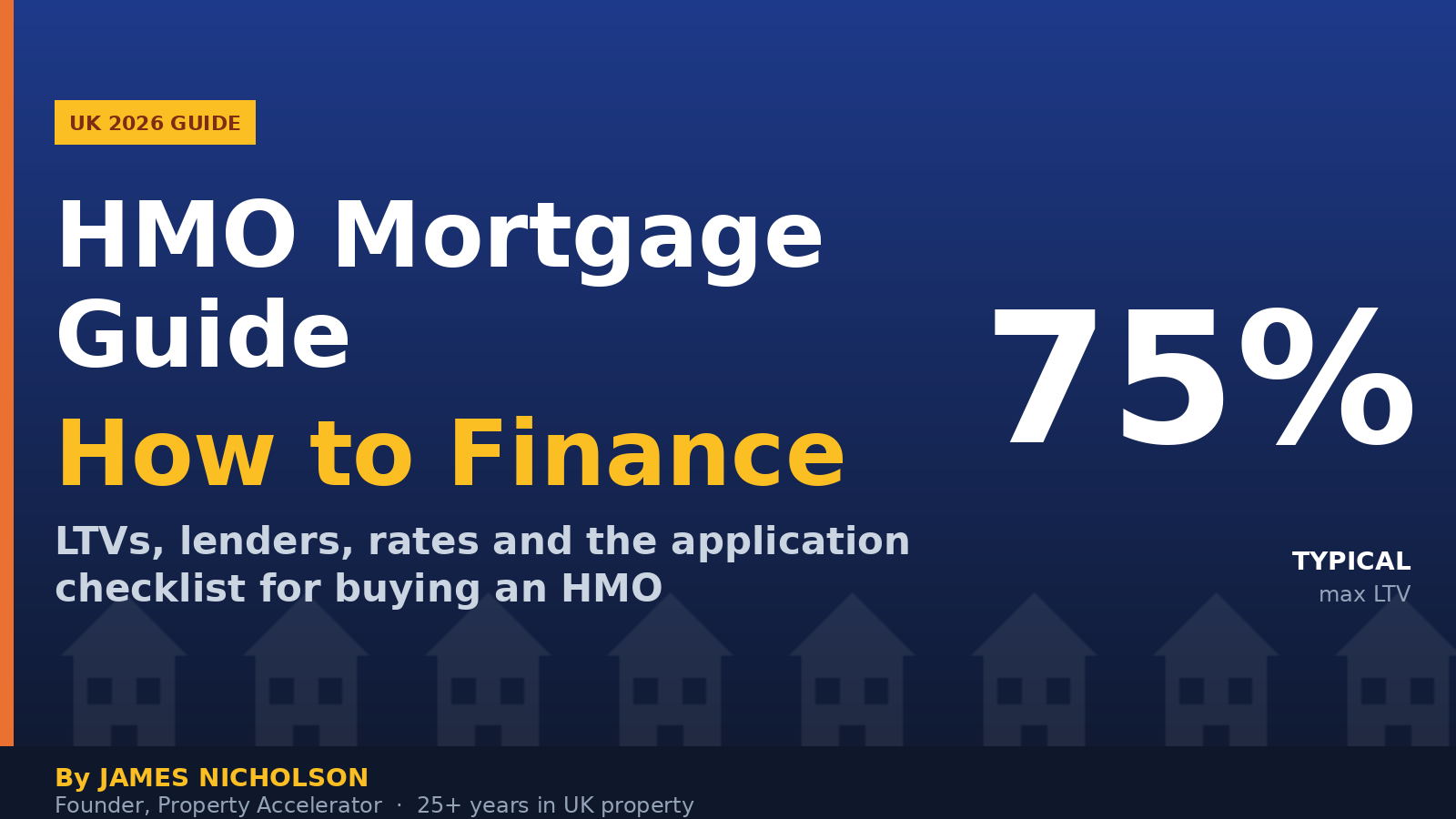
An HMO mortgage is a specialist buy-to-let product for properties let to three or more unrelated tenants. Expect 75% max LTV, rates 0.5%–1.5% above standard BTL, lender fees of 1%–2%, and minimum income of £25k. Specialist lenders like Paragon, Kent Reliance and Foundation will go up to 7+ bed sui generis HMOs where mainstream BTL lenders refuse.
HMO mortgages cost 0.5–1.5% more than standard buy-to-let and need 25% down, because lenders price the specialist underwriting and valuation. Fees matter more than the headline rate — 3–5% arrangement fees are common. Experience, LTV, HMO size and licence status decide where in the band you land.
What is an HMO mortgage?
An HMO mortgage is a specialist buy-to-let mortgage designed for properties rented to three or more unrelated tenants who share kitchen or bathroom facilities. If you try to put a 5-bed shared house onto a standard buy-to-let product, the lender will either refuse it outright or pull the offer when their valuer flags the use class. I’ve seen this happen on completion day — costing the buyer a non-refundable deposit and a chain collapse. So before you offer on an HMO, get the mortgage sorted with a broker who actually places HMO deals.
HMO mortgages come from two camps. Mainstream BTL lenders (BM Solutions, The Mortgage Works, Aldermore) will lend on small “vanilla” HMOs — typically up to 6 beds, single household conversions, no licensing complications. Specialist HMO lenders (Paragon, Kent Reliance, Foundation, Precise, Landbay) handle everything else: large 7+ bed sui generis HMOs, multi-unit blocks, recently refurbished properties, day-one remortgages, and properties in Article 4 zones.
Before reading on, check whether your property even needs an HMO licence. The licensing rules drive the lender’s risk assessment. My pillar guide on how to avoid an HMO licence walks through the five legal strategies. And if your property is a 5+ bed mandatory licence HMO, that’s where most lenders draw the line — you’ll need a specialist.
HMO mortgage vs standard buy-to-let
The headline difference is risk pricing. Lenders see HMOs as higher risk than single-family BTLs for three reasons: higher tenant turnover, more management overhead, and a smaller pool of buyers if they have to repossess. So they price that risk in.
| Feature | Standard BTL | HMO mortgage |
|---|---|---|
| Max LTV | 75%–80% | 75% (60%–70% for large HMOs) |
| Typical rate (5-yr fix, April 2026) | 4.5%–5.2% | 5.4%–6.5% |
| Arrangement fee | 0%–2% of loan | 1.5%–2.5% of loan |
| Stress-test ICR | 125% at pay rate | 145% at pay rate or 5.5% notional |
| Min property value | £50k | £75k–£100k |
| Min landlord income | £20k–£25k | £25k–£40k (some require it) |
| Sui generis (7+ bed) accepted? | No | Yes — specialist only |
LTV, deposits and rates
The maximum loan-to-value (LTV) on an HMO mortgage is almost universally 75%. A handful of specialist lenders will go to 80% on a small “vanilla” HMO, but the rate jump makes it a false economy unless you’re cash-strapped. For larger HMOs (7+ bed), expect 70% LTV. For sui generis or first-time HMO investors with no track record, some lenders cap at 60%–65%.
That means on a £300,000 HMO, you’re putting in £75,000 deposit at 75% LTV, plus around £15,000 in stamp duty (3% surcharge), legal fees, valuation, and lender arrangement fee. So the all-in cash requirement is £90,000–£100,000 before any refurb.
On rates as of April 2026: 2-year fixes are running 5.4%–6.0% from specialists, 5-year fixes 5.6%–6.5%. Most experienced HMO investors take the 5-year fix for stability — the cashflow planning matters more than chasing 0.2% on a 2-year.
Lender comparison
This is a simplified snapshot. Rates change weekly and product availability shifts. Always go through a specialist broker — they’ll have access to lenders who don’t publish products direct.
| Lender | Type | Max beds | Sui generis? |
|---|---|---|---|
| BM Solutions | Mainstream | 6 | No |
| The Mortgage Works | Mainstream | 6 | No |
| Aldermore | Mainstream | 6 | No |
| Paragon | Specialist | 20 | Yes |
| Kent Reliance | Specialist | 10 | Yes |
| Foundation | Specialist | 10 | Yes |
| Precise Mortgages | Specialist | 8 | Yes |
| Landbay | Specialist | 10 | Yes |
| Shawbrook | Specialist | 20 | Yes |
| Vida Homeloans | Specialist | 8 | Yes |
Paragon and Shawbrook are my go-to recommendations for serious HMO investors with portfolios. Foundation is excellent for first-time HMO landlords because of the lower income threshold. Vida is the most accommodating on credit blips. Kent Reliance and Precise sit in the middle for most deal types.
How lenders calculate affordability
HMO mortgage affordability isn’t done on your salary the way a residential mortgage is. It’s done on the property’s projected rental income.
Rental coverage (ICR test): Annual rent must be 145% of the annual interest at either your pay rate or a notional stress rate (typically 5.5%, sometimes 6%).
Top-slicing (specialist lenders): If the rental income falls short of the ICR test, some specialists let your personal income “top-slice” the gap. Paragon, Kent Reliance and Shawbrook all do this. Mainstream BTL lenders don’t.
The valuer’s report matters more on HMOs than on standard BTLs. They give two figures: the bricks-and-mortar value (what it’d sell for as a single-family home) and the investment value (what it’s worth as a working HMO based on rental yield). Mainstream lenders will lend on the lower figure. Specialists will lend on the higher one.
Day-one remortgages and refurb-to-let
If you buy a tired 3-bed semi for £180,000 in cash, refurbish it into a 5-bed licensed HMO, and want to pull your money back out — that’s a day-one remortgage. Most mainstream BTL lenders make you wait 6 months. Specialist HMO lenders will let you remortgage from day one based on the post-refurb valuation.
This is the engine that powers BRR (Buy, Refurbish, Refinance) HMO strategies. Foundation, Kent Reliance and Precise are the lenders most active in this space.
One trap: if you’re getting close to or breaching Article 4 direction rules, the day-one remortgage will fall over because the lender’s valuer can see the use change isn’t permitted. Always check Article 4 status and whether you have planning permission for the HMO use class before structuring a BRR deal.
Application checklist
- Last 3 months of bank statements (personal and Ltd Co if buying through a company)
- Last 2 years of SA302s (or 3 years if self-employed)
- Last 2 years of accounts (if Ltd Co)
- Proof of deposit source
- Existing property portfolio schedule
- HMO licence (if already issued) or application reference number
- Planning permission documents if applicable (especially in Article 4 zones)
- Floor plans showing room sizes (lender wants to verify against HMO room size requirements)
- Refurbishment schedule and costings if doing a BRR
- EPC (must be E or above to let)
If you’re running both HMOs and serviced accommodation, the lender ecosystems overlap but the products differ — see my serviced accommodation mortgage guide for the SA-specific lender criteria, post-FHL tax landscape, and how rate and LTV differ from HMO products.
Frequently asked questions
Can I get an HMO mortgage as a first-time landlord?
It’s harder but possible. Foundation, Vida and Kent Reliance accept first-time landlords on small HMOs (3–5 beds). Most other specialists want at least 12 months of buy-to-let experience.
Can I get an HMO mortgage through a limited company?
Yes — and it’s the most common way HMO investors structure new purchases for tax reasons. Almost all specialist HMO lenders accept SPV limited companies. Rates for Ltd Co HMO products are typically 0.2%–0.4% higher.
What’s the minimum income to get an HMO mortgage?
Most specialist lenders set a minimum personal income of £25,000. Foundation goes to £20,000 and Vida to £15,000. A handful of specialists have no minimum income requirement at all.
How long does an HMO mortgage application take?
Allow 6–10 weeks from application to completion on a vanilla case, 10–14 weeks for complex cases.
Do I need a specialist broker or can I go direct?
You almost always need a specialist broker. Most specialist HMO lenders only distribute through brokers — they have no direct channel.
What about HMO mortgages in Article 4 zones?
Lender criteria in Article 4 zones is tighter. Most specialists require evidence of existing HMO use class before lending. My Article 4 directions guide lists every UK council with restrictions.
Want the full HMO playbook?
HMO Accelerator + Sourcing Bundle
Lender contacts, deal structuring templates, BRR refinance checklist, and the exact criteria specialist lenders use. From £197.
HMO mortgage rates in 2026 — what you’ll actually pay
HMO mortgage rates consistently sit 0.5–1.5% above standard buy-to-let at the same LTV. You’re paying for specialist underwriting, not the bricks — and fees move the total cost more than the headline rate does.
Rates move weekly, so a table of today’s prices would be stale in a month — but the structure of HMO pricing barely changes, and that’s what catches people out. Here’s what determines where in the band you land:
A 3–5% arrangement fee on a low headline rate is common in the HMO market. On a £200k loan that’s £6,000–£10,000 added to the balance. Always compare total cost over the fixed period, not the rate in the advert.
The valuation method changes the maths more than the rate does. Some lenders value HMOs on bricks-and-mortar, others on commercial yield — on a high-cashflow HMO in an Article 4 area, a commercial valuation can come in 20–30% higher, which means more equity released when you refinance after a refurb.
Not sure whether your property needs a licence in the first place? Start with my guide to HMO licensing rules.
Frequently asked questions
Are HMO mortgages more expensive than buy-to-let?
Yes, typically 0.5 to 1.5 percent higher than a standard BTL at the same LTV, plus larger arrangement fees, reflecting the specialist underwriting involved.
How much deposit do I need for an HMO mortgage?
Usually 25 percent minimum, with the best rates from 35 to 40 percent down. Larger HMOs of seven or more bedrooms are assessed on commercial terms.
Can a first-time landlord get an HMO mortgage?
It is harder and pricier. Many HMO lenders want prior landlord experience; first-timers pay a premium and have a smaller lender panel until they build a track record.

Download NOW
4 Simple Steps To Becoming Wealthy Through Property