

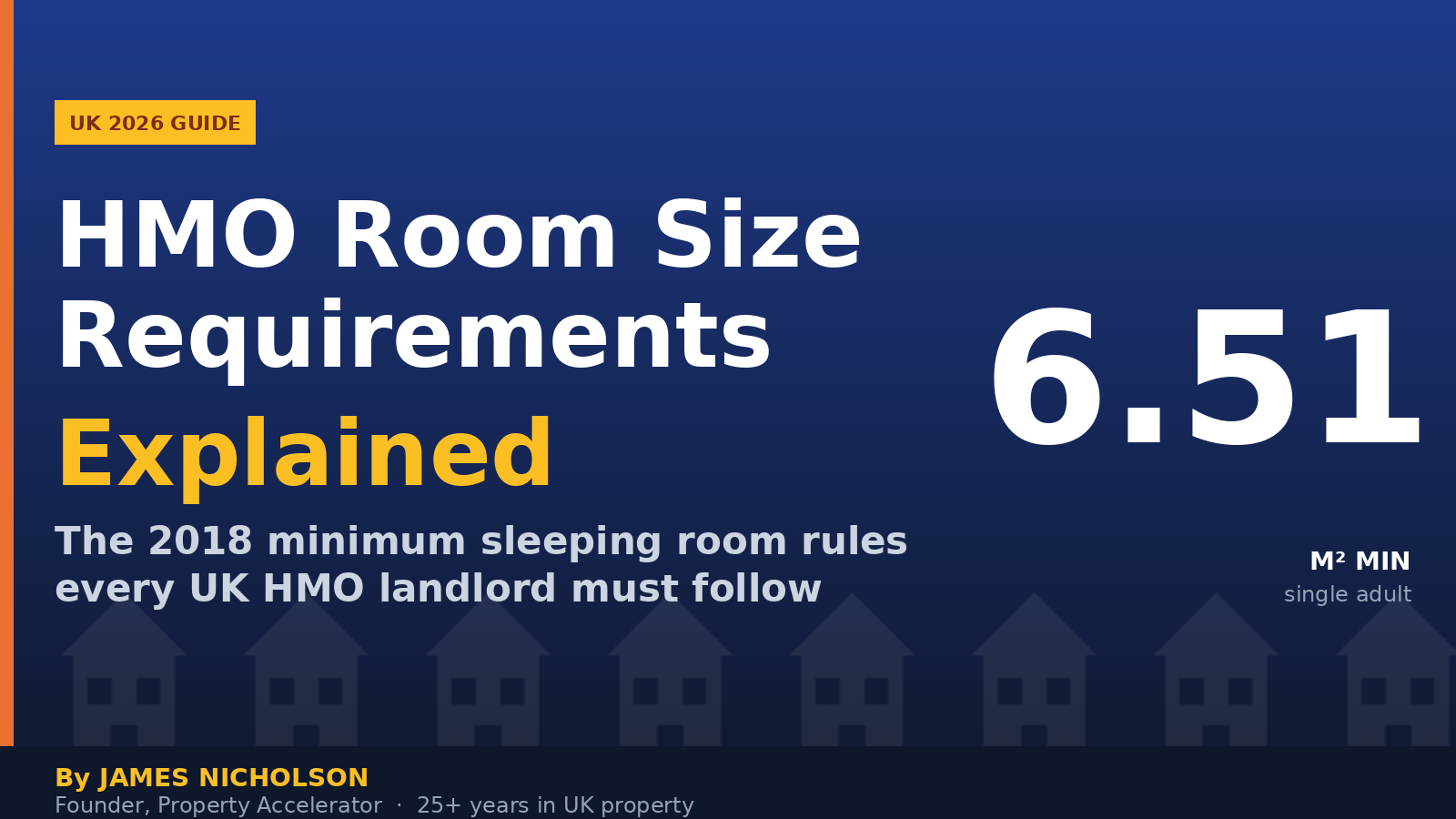
Since October 2018, mandatory HMO licences in England require minimum sleeping room sizes: 6.51m² for one person aged 10+, 10.22m² for two adults, and 4.64m² for a child under 10. Rooms below these sizes cannot legally count as bedrooms in a licensed HMO.
For more on this, see our deeper guide on HMO licensing and cashflow guide for UK landlords.
The rules also exclude floor area below 1.5m head height. Many older terraced houses and converted lofts fail without obvious modification.
Room sizes catch more first-time HMO investors than any other compliance issue. People look at a 5-bed Victorian terrace, do the maths, and only later discover that the smallest “box room” is 5.8m² and won’t legally count under the licensing rules.
The 2018 minimum sleeping room sizes
Since 1 October 2018, all mandatory HMO licences in England must specify maximum occupancy by room. The minimum sizes are:
- One person aged 10 or over: 6.51m² (~70 sq ft)
- Two persons aged 10 or over: 10.22m² (~110 sq ft)
- One person aged under 10: 4.64m² (~50 sq ft)
Important detail: any floor area where the ceiling height is below 1.5 metres is excluded from the calculation. This catches a lot of converted-loft bedrooms with sloping eaves.
Why the rules changed
Before October 2018, England’s HMO licensing rules referred to a 1985 Housing Act standard that simply said rooms had to be “fit for human habitation” — vague enough that some councils accepted 4m² as a single-occupant bedroom. After several high-profile cases of overcrowding, the Government introduced specific square-metre minimums in the Houses in Multiple Occupation (Mandatory Conditions of Licences) (England) Regulations 2018.
The rules apply to all mandatory licensable HMOs — meaning 5+ occupants from 2+ households, sharing facilities. They don’t apply automatically to additional-licensing HMOs (3-4 occupants), but most councils running additional schemes have written equivalent or stricter conditions into their licence terms.
How to measure a room correctly
Council inspectors don’t measure to the wall, top to bottom. They measure usable floor area, which is more restrictive than what your agent’s brochure shows.
- Wall to wall. Measure the full internal floor area of the room.
- Subtract floor area where ceiling is below 1.5m (e.g. under sloping loft eaves).
- Subtract built-in furniture not removable (e.g. a fitted wardrobe taking up floor space). Free-standing furniture doesn’t count against you.
- Don’t include en-suite or vestibule areas in the bedroom measurement.
If a room is borderline (within 0.5m² of the threshold), get a chartered surveyor to measure it formally and provide a signed letter. Costs £100-£300.
What counts and doesn’t count as a bedroom
Beyond size, the room must:
- Have a window that opens, of adequate size for both ventilation and emergency escape
- Have natural daylight (windowless internal rooms don’t qualify)
- Have an FD30 fire-rated door
- Have a smoke alarm mains-wired and interlinked with the rest of the property
- Have direct access to a fire-separated escape route
What to do if a room is borderline
- Reconfigure the room. Remove a fitted wardrobe to free up floor area.
- Use the room for a non-sleeping purpose. A 5m² room can be a study or desk space — just not a licensed bedroom.
- Apply for a Standards Variation. Some councils have a discretion in exceptional cases. Don’t rely on it — it’s rare.
- Don’t bother licensing. If keeping the property under 5 occupants gets you out of mandatory licensing entirely, that may be the easier route. See our guide on how to legally avoid an HMO licence.
Enforcement and penalties
Inspectors usually check room sizes at the initial inspection. If a room is found to be too small after the licence is granted, the council can vary your licence to reduce the maximum occupancy, refuse renewal at the end of the 5-year term, issue an Improvement Notice, or in serious cases prosecute under the housing act.
Frequently asked questions
Do these sizes apply to additional-licensing HMOs (3-4 occupants)?
Not by national law, but most councils have written equivalent or stricter conditions into their additional licensing schemes. Check the specific council’s licence conditions.
What if my property is in Wales or Scotland?
Wales has its own room standards under Housing (Wales) Act 2014. Scotland’s Housing (Scotland) Act 2006 standards are similar too. Always check the specific national regulations.
Can I include the en-suite area in my bedroom measurement?
No. The en-suite is a separate room; the bedroom measurement excludes it.
What if I rent a 6.51m² room to a couple?
Not allowed. Two adults need 10.22m². If you let a 6.51m² room to a couple, you’re in breach of your licence conditions immediately.
Where’s the official source for this?
The Houses in Multiple Occupation (Mandatory Conditions of Licences) (England) Regulations 2018 on legislation.gov.uk are the statutory source.
Want the full HMO playbook?
Room compliance is one piece. The Property Accelerator covers finding deals, managing properties, and scaling.
Download NOW
4 Simple Steps To Becoming Wealthy Through Property